A one-sentence journal is one line a day, written when the day is over. It is not a productivity log, not a gratitude list, not a mini-diary. The line is for carrying forward one thing you actually noticed. It is what the evening's four Reflect questions leave you with, given a clearer shape by a final step called Refine.
A day that is still going
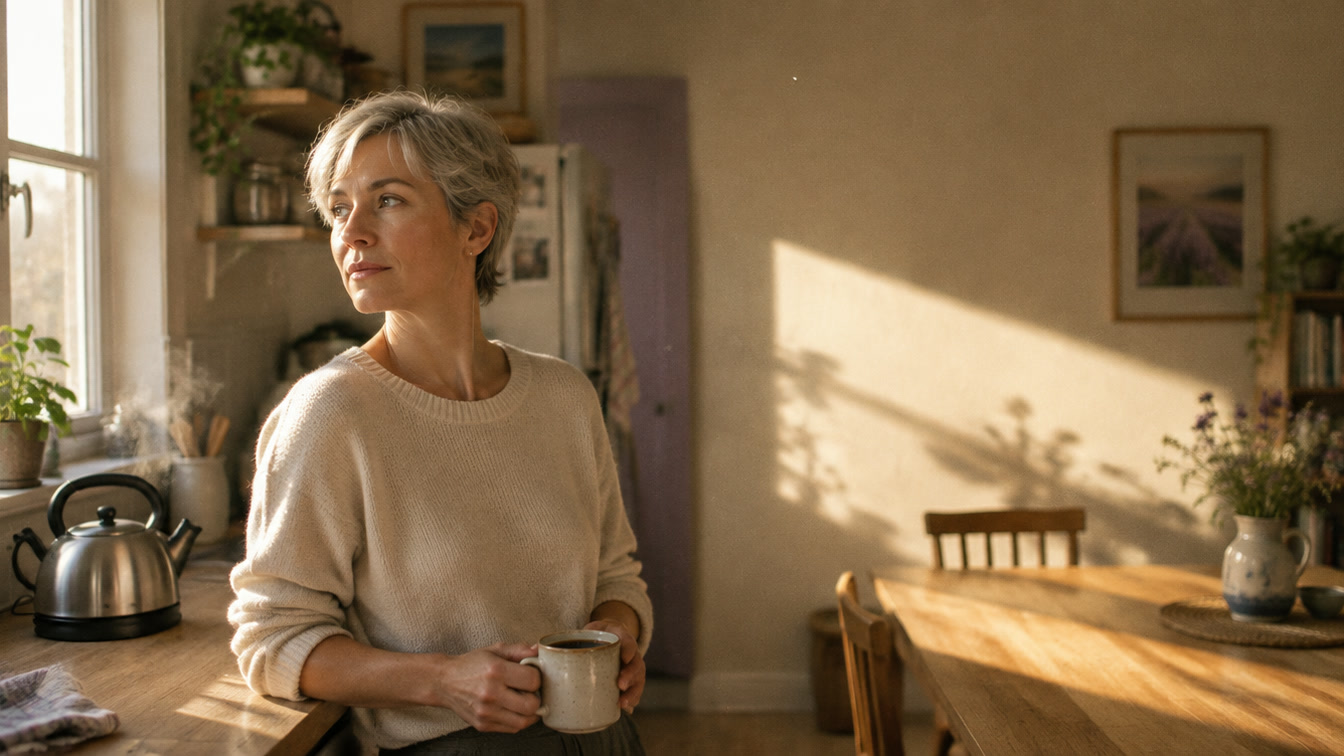
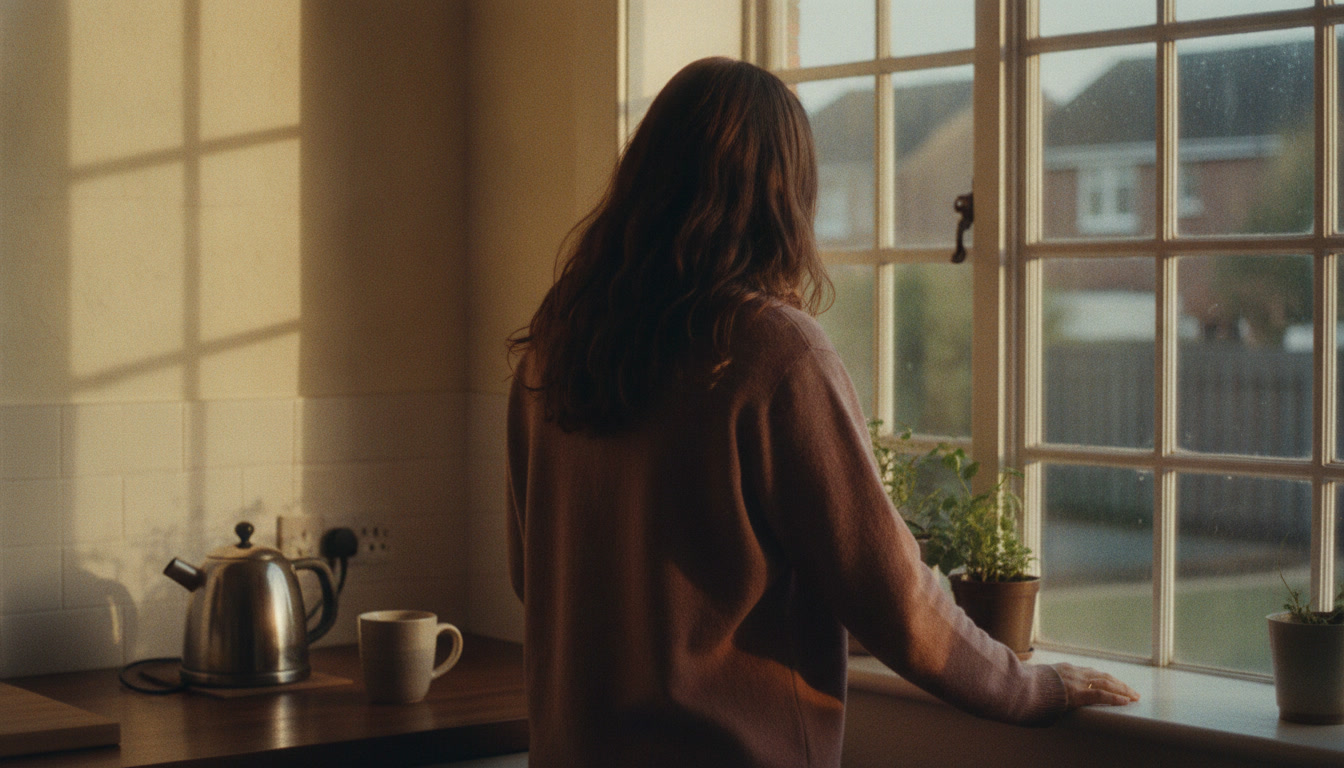
The kettle has boiled and the mugs are in the drainer, but the day is not finished. You are standing in the kitchen at ten, or sitting on the edge of the bed with the lamp still on, and the hours you lived keep moving somewhere behind your eyes. A phone call that left you restless. A bus ride where nobody spoke. A meeting you were only half in. A small argument that ended in a shrug. Nothing worth retelling, and still the day will not set.
That is the strange thing about an ordinary day: it keeps running until someone looks at it. Not to fix it, not to grade it — just to see that it happened. The one-sentence journal begins here, not with a blank page that has to be filled but with a single question asked at the very end of the day.
What a one-sentence journal is
A one-sentence journal is exactly what it says: one line a day, written when the day is over. It is not a productivity log, because there is no list of what got done and nothing to mark complete. It is not a gratitude list, because nothing requires you to find a silver lining on a day that did not offer one. It is not a mini-diary, because there is no obligation to summarise the day or do it justice.
It is one line, and the line is a choice. Out of everything the day contained — the errands, the conversations, the half-thoughts, the small irritations and the small pleasures — you pick a single thing and carry it forward in a sentence. A one line a day journal is not a shorter diary; it is a different object altogether. The point is not to record more in less space. The point is to notice one thing clearly enough to name it.
One sentence journaling changes the question you ask yourself at the end of a day. Instead of "what happened?" — which is the diary's question, and which ends in a long list — it asks "what do I want to keep?" A list has no opinion. A single line is, in itself, an opinion: of everything the day was, this is the part I am choosing to hold.
Where the line comes from
The line does not come out of thin air. In the practice it is the last step, and it follows four questions asked at the end of the day. These are the evening Reflect questions:
- "What happened today worth remembering?"
- "What did today leave you with?"
- "What did you notice about yourself or others?"
- "Is there anything you'd like to carry into tomorrow?"
The first three look back at the day that just passed. The fourth reaches a little way into tomorrow, but only far enough to ask whether anything wants to come along. None of them asks you to fix anything, plan anything, or promise anything. They only ask what is there. The one line grows out of whatever these questions turn up — usually not the biggest event of the day, but the one that is still faintly warm when the others have cooled. If you want the fuller evening that sits before this step, it is its own practice: the four evening Reflect questions.
Refine: giving a line its shape, without turning it into a task
The step that turns a surfaced noticing into a one-sentence journal entry is called Refine. Its whole job is small and specific: Refine gives an observation a clearer shape. It is not a commitment to act. It is not a resolution, not a plan, not an intention. It is the difference between "I noticed something" and "I noticed this, and I can say what it was."
Four checks do the shaping.
Is it one line? The first check is the simplest and the strictest. If the thought needs two sentences, it is still doing the diary's job. One line forces a choice: of everything the day held, which single thing do you actually want to keep? The limit is not a restriction; it is the shape of the whole exercise.
Is it something you noticed, rather than something you resolved to do? This is the heart of Refine. A resolution points at tomorrow and carries a task; an observation points back at the day and carries what was really there. "I will call my sister" is a job you have just given yourself. "I noticed I kept putting off the call and felt lighter each time I did" is a fact about the day. Refine keeps you on the side of the fact.
Would you still recognise it tomorrow? A good line holds a particular day, not a general one. "The meeting was hard" could have been written about any Tuesday. "I said yes to the deadline and heard my own voice do it" is one specific meeting. If the line would fit any day of the week, it is not carrying this one.
Does it leave you free to do nothing about it? The most distinctive check, and the one people trip on. If a line quietly demands that you act on it, it has turned back into a resolution. A real Refine line sits there untouched and is complete. You are allowed to notice something and simply let it be, with no follow-up owed to anyone.
That is the whole of the step: four questions at night, one line carried forward, and nothing you are obliged to do with it. Refine is the last part of the six-minute practice — four questions in the morning, four at night, one line to carry.
A line is not a resolution
The difference between an observation and a resolution is easy to describe and surprisingly easy to blur in the moment. It helps to see them side by side, on the same kind of day:
| The day | A line that is a resolution | A line that is an observation |
|---|---|---|
| The kitchen at ten, the counters still not wiped | "I will clean the kitchen first thing tomorrow." | "The kitchen at ten, and the day still sitting on the counter." |
| A full bus, everyone quiet | "I will stop letting slow commutes get to me." | "The bus was full and no one spoke, and for once that was fine." |
| A meeting that ran long | "I will speak up earlier next time." | "I watched the clock more than the person talking." |
| A phone call with a friend | "I will call my friends more often." | "She laughed before I had finished the sentence." |
Both columns are true things a person might write at the end of the day. The difference is where each one points. The resolution points ahead and sets a job; the observation points back and holds the day. The observation is not more virtuous and the resolution is not wrong — they are simply different tools, and a one-sentence journal uses the second one.
When there is no line, and why one line is enough
Some evenings, no line arrives. The four questions get asked and nothing surfaces — or something surfaces but will not settle into a sentence. That is not a failure. A day can end with no line at all, and the practice loses nothing for it. There is nothing to catch up on and nothing to make up for, because a line that is forced is not a noticing; it is homework. The empty evening is itself a kind of answer: the day was full, and nothing asked to be carried. That is allowed.
And for this particular job, one line genuinely beats a page. Not because it is faster or more efficient — that would be the wrong reason — but because of what it refuses. There is no page to fill, so the writing stops the moment the thing has been said. There is nothing to keep up, so a missed day costs nothing and leaves no debt. There is nothing to review later, so the line never becomes data to be sifted. It is a small anchor you can read in ten seconds, or never read again. Either way it has done its job, which was only ever to let the day be noticed once, and named.
A practice needs a place that keeps it.
Frequently Asked Questions
What is the difference between a one-sentence journal and a diary?
A diary records a day; a one-sentence journal carries a single line from it. The diary tries to hold the day as it happened, while the one line holds only the one thing you noticed clearly enough to name. One is a record, the other is a noticing.
How long should a one-sentence journal entry be?
One sentence. The first Refine check exists for exactly this reason: if the thought needs two sentences, it is still doing the diary's job. One line is the whole shape, not a minimum or a maximum.
What if I miss a day?
Nothing happens, and nothing is owed. A one-sentence journal has no backlog to clear and nothing to protect. A missed day simply has no line, and the practice continues the next evening without any catching up.
Do I have to act on what I write?
No. The fourth Refine check — "Does it leave you free to do nothing about it?" — is there precisely so the line does not become a task. You are allowed to notice something and let it be.
Is a one-sentence journal the same as a gratitude list?
No. A gratitude list asks you to find something to be thankful for; a one-sentence journal asks only what you noticed. Some days the line will be warm and some days it will not, and neither is more correct.