
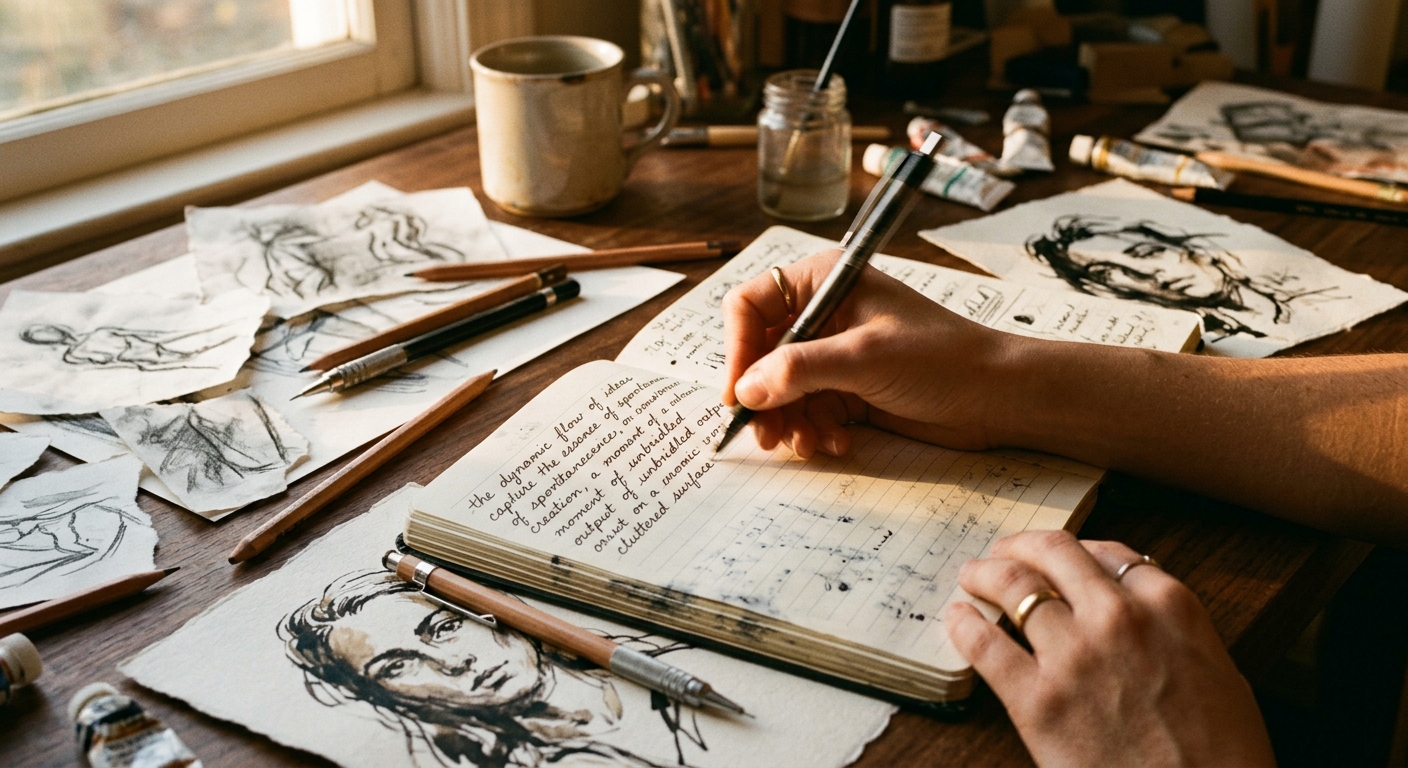
You sit down to write, design, compose, or plan — and nothing comes. Not because you lack ideas, but because your mind is still running six other tabs: the email you haven't answered, the conversation that didn't land right, the vague sense that you're forgetting something. Creative work needs a clear channel, and most days, that channel is jammed with noise that has nothing to do with the work itself.
This is where journaling earns its place in a creative practice — not as a nice-to-have ritual, but as a functional tool for clearing the channel. Writing before you create doesn't just "get you in the mood." It does something more specific: it offloads the mental clutter competing for your attention, so the part of your mind responsible for making new connections has room to work.
This guide walks through why that happens, and how to build a journaling practice that reliably moves you toward creative flow — plus prompts for the moments when the block feels stubborn.
Why Writing First Changes What Happens Next
Flow state — the experience of being fully absorbed in a task, where effort feels effortless and self-consciousness drops away — was named and studied extensively by psychologist Mihaly Csikszentmihalyi. His research identified a consistent precondition for flow: a clear goal and a mind free of competing demands on attention. Flow doesn't arrive when your working memory is split between the task and everything else you're tracking. It arrives when there's nothing left to track.
That's the mechanism journaling exploits. Cognitive scientists have long documented a phenomenon sometimes called the "cognitive offloading" effect: writing something down — even briefly — reduces the mental effort required to keep holding it in mind. Once a thought is on paper, your brain treats it as handled. It stops rehearsing it in the background. That freed-up capacity is exactly what creative thinking needs, because ideation draws on working memory to hold multiple loose associations at once and let them collide.
There's a second, related effect specific to creative output. Early-stage ideation benefits from reduced self-censorship — the willingness to generate a bad idea in service of eventually finding a good one. Free writing and stream-of-consciousness journaling, without editing or judgment, lower the internal editor's volume. You write faster than you can evaluate, which is precisely the point: judgment is useful later, in refinement, but it's often the thing killing ideas at the moment they're born.
Put together: journaling before creative work does two things simultaneously. It clears the attentional runway, and it loosens the self-editing that blocks new ideas from surfacing in the first place.
The Flow-Entry Ritual: A Warm-Up Before the Work
Athletes warm up before they perform. Writers, designers, and thinkers benefit from the same principle, and journaling is a natural warm-up format because it requires no equipment, no outcome, and no audience.
Here is a simple structure to use before any creative session — 5 to 10 minutes is enough.
1. Brain dump (2–3 minutes). Write down everything currently occupying your attention that isn't the creative task: unanswered messages, errands, worries, half-formed to-dos. Don't organize it. Just get it out of your head and onto the page. The goal isn't insight — it's eviction.
2. Orient to the work (1–2 minutes). Name, in a sentence or two, what you're about to make or solve. What's the shape of the problem? What would "done for today" look like? This isn't a plan — it's a compass heading, just specific enough to point your attention somewhere.
3. Associative free write (3–5 minutes). Without stopping to edit, write anything that comes to mind related to the work — half-ideas, adjacent images, questions, contradictions, things you're curious about. Let it be messy and non-linear. This is the step that most directly primes ideation: you're rehearsing the mental motion of generating without judging, right before you need to do exactly that in the work itself.
By the time you close the notebook, the noise is on the page instead of in your head, and your mind has already been moving in the direction of the problem for several minutes. That's a meaningfully different starting point than opening a blank document cold.
Techniques for Specific Creative Moments
Different creative situations call for different journaling approaches. A few that map to common sticking points:
Morning pages, for daily creative momentum. Three pages of unstructured, stream-of-consciousness writing first thing in the day — popularized by artist Julia Cameron — works less because of what you write and more because of what it clears out before your creative hours begin. The content is disposable. The clearing is the point.
Mind-mapping in the margins, for generating volume. Write a central concept in the middle of the page and let associations branch outward, without worrying about which branches are "good." Ideation research consistently shows that quantity of ideas is a strong predictor of eventual quality — the more raw material you generate, the more likely a genuinely useful idea is somewhere in the pile. A journal page is a low-stakes place to generate volume without the pressure of a shared document or a client-facing deck.
Constraint writing, for breaking a stuck pattern. When you're circling the same unsatisfying idea, impose an arbitrary constraint on your journaling: describe the problem using only questions, or write the solution as if explaining it to a child, or list ten deliberately bad answers before allowing a real one. Constraints interrupt the default thought pattern that got you stuck in the first place, which is often exactly what's needed to see the problem differently.
End-of-session capture, for continuity. Before closing a creative session, spend two minutes writing what you were circling when you stopped — the thread you were pulling on, the question you hadn't resolved. This does double duty: it makes tomorrow's warm-up faster (you're not reconstructing context from scratch) and it often lets your mind keep working on the problem passively between sessions, a phenomenon sometimes called incubation.
When the Block Isn't About Warming Up
Sometimes the problem isn't a cold start — it's a specific block that a five-minute ritual won't move. A few prompts for that:
- What am I afraid this idea says about me if it's bad? Creative block is frequently a judgment problem wearing an ideas costume. Naming the fear on paper often does more than trying to out-think the block directly.
- What would I make if no one would ever see it? This removes the audience from the equation temporarily, which can unstick perfectionism-driven paralysis.
- What's the most obvious idea I've been avoiding because it feels too simple? Blocked creative sessions often circle elaborate solutions while overlooking a plain one sitting in view.
- What did I notice today that had nothing to do with this project? Cross-domain observations — something overheard, a texture, an unrelated problem someone described — are common sources of the "unexpected connection" that ideation research identifies as central to genuinely novel ideas.
None of these are guaranteed to dissolve a block in one sitting. But they reliably move you from staring at nothing to generating something — and something is what the next idea gets built from.
Applying the 3R Framework to Creative Work
The Record → Reflect → Refine framework, usually discussed in the context of emotional processing, maps just as naturally onto creative practice:
Record — the warm-up brain dump and associative free write. Capture everything without judgment, including the bad ideas. You can't refine what you haven't recorded.
Reflect — periodically (weekly works well), read back through recent creative journal entries. Patterns emerge that aren't visible entry by entry: recurring themes you keep circling, ideas you dismissed too quickly, a constraint you keep running into. This is where AI-assisted summaries can help — surfacing threads across many entries that would take real effort to spot by scanning manually.
Refine — take the pattern or idea that survived reflection and develop it deliberately in the actual work — the document, the sketch, the composition. Journaling generates the raw material; refinement happens in the medium where the work actually lives.
Treating your creative journal as a system rather than a diary — something you write into and also periodically read back through — is what turns scattered ideation into a practice that compounds over time.
A Note on Honest Ideation
Early-stage ideas are often embarrassing. Half-formed, derivative, obviously bad in hindsight — that's not a flaw in the process, it's what the process looks like before refinement. But that also means creative journaling works best when you trust that no one is going to read the bad ideas before you've had the chance to discard them yourself.
If you're keeping a creative journal digitally, that's worth thinking about. MindfulFlow Journal encrypts entries end-to-end on your device, so the raw text isn't accessible on our servers, and when AI features summarize patterns across your entries, they work from sanitized summaries rather than your original writing. The point isn't a security pitch — it's that genuinely uninhibited ideation, the kind that produces the associative leaps this guide is about, tends to happen more easily when you're not quietly self-editing for an audience, even an imagined one.
Getting Started This Week
Pick one creative session this week — a writing block, a design sprint, a practice session, whatever your work looks like — and run the three-step flow-entry ritual before you start: brain dump, orient, associative free write. Ten minutes, no editing.
Notice what's different about how quickly you get moving, compared to starting cold. Then, at the end of the week, read back through what you wrote. You'll likely find at least one idea worth keeping that you would have talked yourself out of if you'd tried to evaluate it in the moment it appeared.
That's the practice: write first, judge later, and let the page do the work of clearing space that your mind can't clear on its own.
Ready to build a creative journaling habit? MindfulFlow Journal's guided prompts and flow-entry rituals help you clear mental noise before you create, with AI-assisted pattern summaries that surface your best recurring ideas — without ever exposing your raw entries. Try it at mindfulflowjournal.com.
What does your pre-creative ritual look like — or do you usually just start cold? Share in the comments.