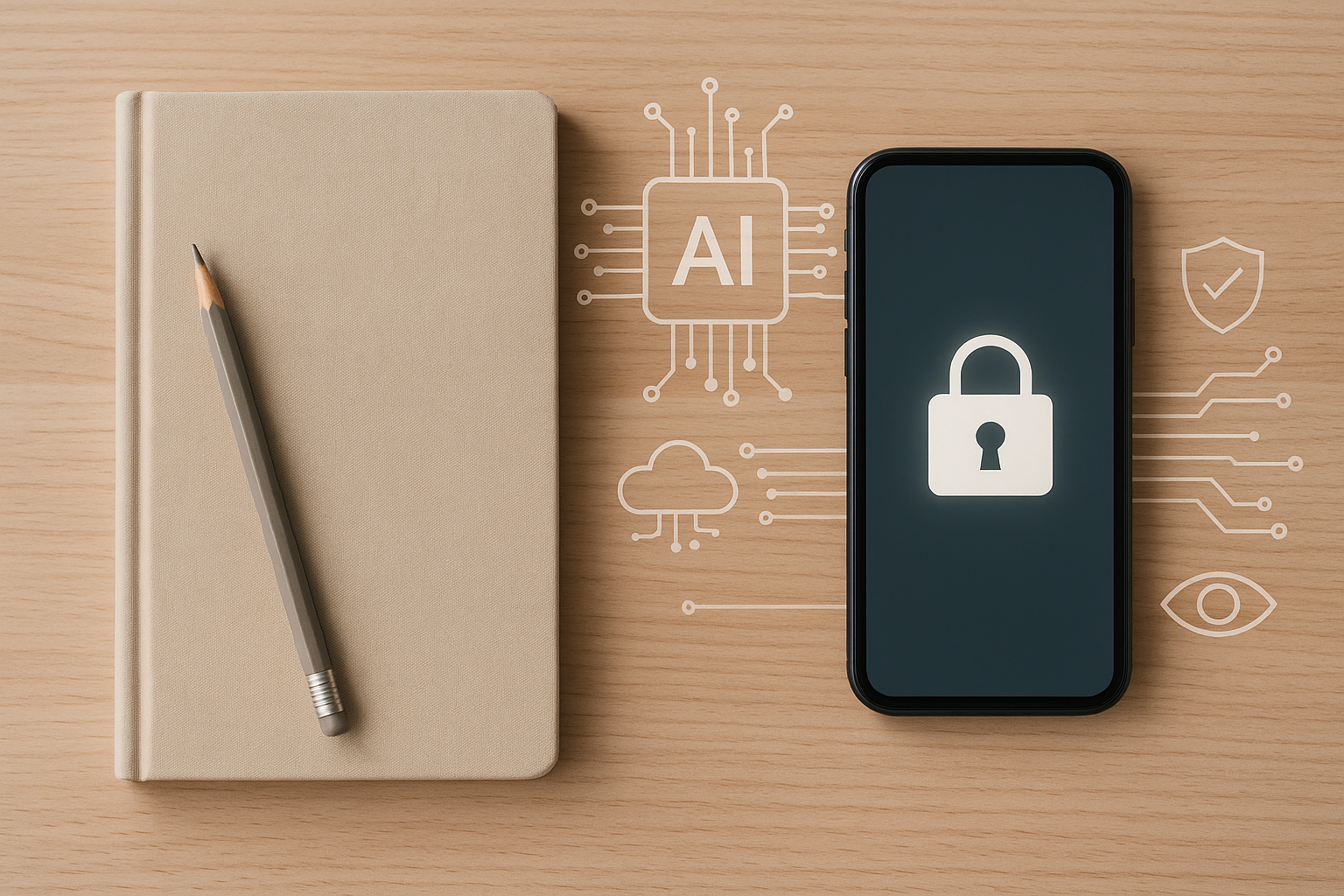
Privacy concerns with closed and proprietary AI models for journaling come down to one question: what happens to your diary entries after you press save? With a closed AI system you cannot inspect the underlying model or infrastructure — you depend entirely on the company's stated policies. The biggest risks are weak encryption, vague AI training clauses, limited deletion controls, and entries that may be reviewed or retained without your knowledge.
That is why these questions matter more for journaling than for almost any other app category. Journals hold your most personal reflections, relationship stress, work worries, and private memories. Before trusting any closed or proprietary AI tool with that kind of writing, it helps to know exactly what protections to look for.
These concerns are not only reasonable—they are essential to address. Surveys consistently show that privacy is one of the top barriers preventing people from using digital wellness tools (APA Monitor). Let’s look at what privacy and security really mean in the context of AI-assisted journaling.
Quick Answer: Is It Safe to Use AI as a Personal Diary?
It can be safe, but not by default. An AI journaling tool is safer when it:
- encrypts entries in transit and at rest
- explains whether your writing is ever used for AI training
- lets you export and delete your data
- minimizes who can access your entries
- ideally offers end-to-end encryption, so the provider cannot read your private text
If an app is vague about any of those points, that is a signal to slow down and look more closely.
Why Privacy Matters So Much in Journaling
Unlike fitness trackers or budgeting apps, journaling tools deal with thoughts and emotions—the most personal data possible. A breach of this data can feel not only like a security failure, but also like a betrayal of trust. According to research published in JMIR mHealth and uHealth, privacy concerns significantly affect adoption rates for digital mental health tools (source).
For journaling apps, the privacy bar must be even higher: users expect their entries to remain as confidential as a locked paper diary.
The Main Privacy Concerns With AI Diary Apps
When people ask whether it is private to use AI as a diary, they are usually asking about four separate issues:
-
Who can access the raw text?
If your entries are readable on the provider’s servers, employees, contractors, or subprocessors may be able to access them under some conditions. -
Is your writing used to improve AI models?
Some products may retain prompts or use customer data for training, evaluation, or quality review unless they explicitly say otherwise. -
How much control do you have over deletion?
It should be easy to delete entries and close your account, with clear information about how backups are handled. -
Are the protections strong enough for deeply personal writing?
Basic cloud encryption is better than nothing, but it is not the same as end-to-end encryption. The strongest setup is one where your writing is encrypted on your device before upload and only you hold the key.
These are especially important concerns with closed AI models, where users may not be able to inspect how data is processed behind the scenes.
How Journaling Apps Handle Your Data
The first question to ask about any journaling app is what happens to your writing once you hit save. Most apps fall into three categories:
- Local-only storage: Entries never leave your device. This is the most private option but often lacks cross-device sync.
- Cloud-synced, encrypted storage: Entries are stored on servers, but protected with strong encryption. This allows you to access your journal across devices while keeping data safe in transit and at rest.
- End-to-End Encrypted (E2EE) storage: Your entries are encrypted on your device before being uploaded, and only you hold the decryption key. Even the app provider cannot read them. Signal and ProtonMail use this model for messaging and email, and some journaling apps now follow suit.
Each approach has trade-offs between convenience and security, but the trend is clear: users increasingly expect E2EE as a gold standard.
Privacy Concerns With Closed AI Models for Journaling
Closed AI systems are not automatically unsafe, but they do require more trust. If you cannot inspect the model or infrastructure yourself, you depend on the company’s policy, technical safeguards, and transparency. That makes it important to look for plain-language answers to questions like:
- Is journal text stored after analysis?
- Is it reviewed by humans for safety or quality checks?
- Is it excluded from model training by default?
- Can you turn AI features off and still keep your journal?
The OECD Principles on AI emphasize transparency and user control as core values for trustworthy AI systems (OECD AI Principles). In practice, responsible apps should clearly explain their data flow instead of hiding it in vague legal language.
Is Your Writing Used to Train AI?
Another concern is whether your private entries are being fed into AI models. While some companies do use customer data for machine learning, many responsible journaling apps now adopt a “no training without consent” policy.
In practice, reputable apps should:
- Clearly state whether your data is ever used for AI training.
- Offer opt-in (not opt-out) consent for sharing anonymized data.
- Explain how anonymization works (for example, removing personal identifiers before any analysis).
If this information isn’t in the privacy policy or help documentation, it’s worth questioning the app’s commitment to user trust.
The Role of Encryption
Encryption is the backbone of digital privacy. At a minimum, journaling apps should use:
- Transport Layer Security (TLS): Protects data while it’s being sent between your device and servers.
- Encryption at Rest: Protects stored data on servers against unauthorized access.
- End-to-End Encryption (optional): Ensures no one but you can ever read your entries.
The National Institute of Standards and Technology (NIST) recommends AES-256 and similar algorithms for strong protection (NIST Guidelines). For users, this technical detail may sound abstract, but in practice it means your data is locked in a digital safe that even the app provider cannot open when end-to-end encryption is implemented correctly.
Transparency and Control
Trust grows when users feel in control. Good journaling apps should provide:
- Clear privacy policies written in plain language.
- Data export features so you can download your entries.
- Delete account options that erase your entries completely.
- Consent management settings so you can decide if your data is ever used for research or AI improvements.
These controls align with global data protection laws like the GDPR in Europe and CCPA in California, which give individuals rights over their digital data.
Questions to Ask Before You Trust an AI Journal App
Before choosing a tool, ask:
- Can the company read my journal entries, or are they end-to-end encrypted?
- Is my writing ever used to train AI models?
- What happens if I delete an entry or close my account?
- Can I export my journal in a usable format?
- Does the app explain its privacy model in plain English?
If you are comparing options, this guide on how to find the best AI-assisted journaling app for your needs can help you evaluate privacy alongside features. You can also read are digital journaling apps safe and private? for a simpler high-level overview.
FAQ: Using AI as a Personal Diary
Is it private to use AI as a personal diary?
Sometimes, but not always. Privacy depends on whether the app encrypts your entries, limits provider access, and clearly explains its AI data policy. If the company is vague about any of those protections, assume the privacy model is weaker than you want for diary-style writing.
What are the privacy concerns of using closed AI models for journaling or diary apps?
The main concerns are data retention without clear limits, vague or opt-out AI training policies, potential human review of entries, and limited visibility into how your text is processed. Closed systems can still be trustworthy, but because you cannot inspect the infrastructure yourself, they need much stronger transparency to earn that trust.
What are the privacy concerns of using proprietary AI for journaling?
Proprietary and closed AI systems share the same core privacy risk: you cannot independently verify how your writing is handled. Key concerns include whether entries are stored after analysis, whether they are used for model training, and whether human reviewers can access them. A responsible proprietary AI journaling app will answer all three questions plainly in its privacy policy — if it does not, treat that as a red flag.
Is end-to-end encryption important for AI journaling?
Yes. It is one of the clearest signals that an app treats private writing seriously. End-to-end encryption means your entries are encrypted before they leave your device, reducing the chance that the provider can read them on the server side.
Should you use ChatGPT or Claude as a diary?
That depends on your comfort with the product’s privacy terms and your own risk tolerance. For highly personal reflection, many people prefer a dedicated journaling app with stronger privacy controls, clearer deletion options, and a data model built specifically for private writing.
Takeaway
AI-assisted journaling can offer real benefits—insights, mood tracking, and reflection prompts—but it’s only valuable if you trust the app with your most personal thoughts. Look for apps that:
- use strong encryption, ideally end-to-end
- make it clear that your data belongs to you
- do not use your writing for AI training without explicit permission
- provide tools to export and delete your data
- explain their privacy model in plain, human language
In the end, the best AI journaling app is not just the one with clever features. It is the one that treats your private reflections with the respect and security they deserve.