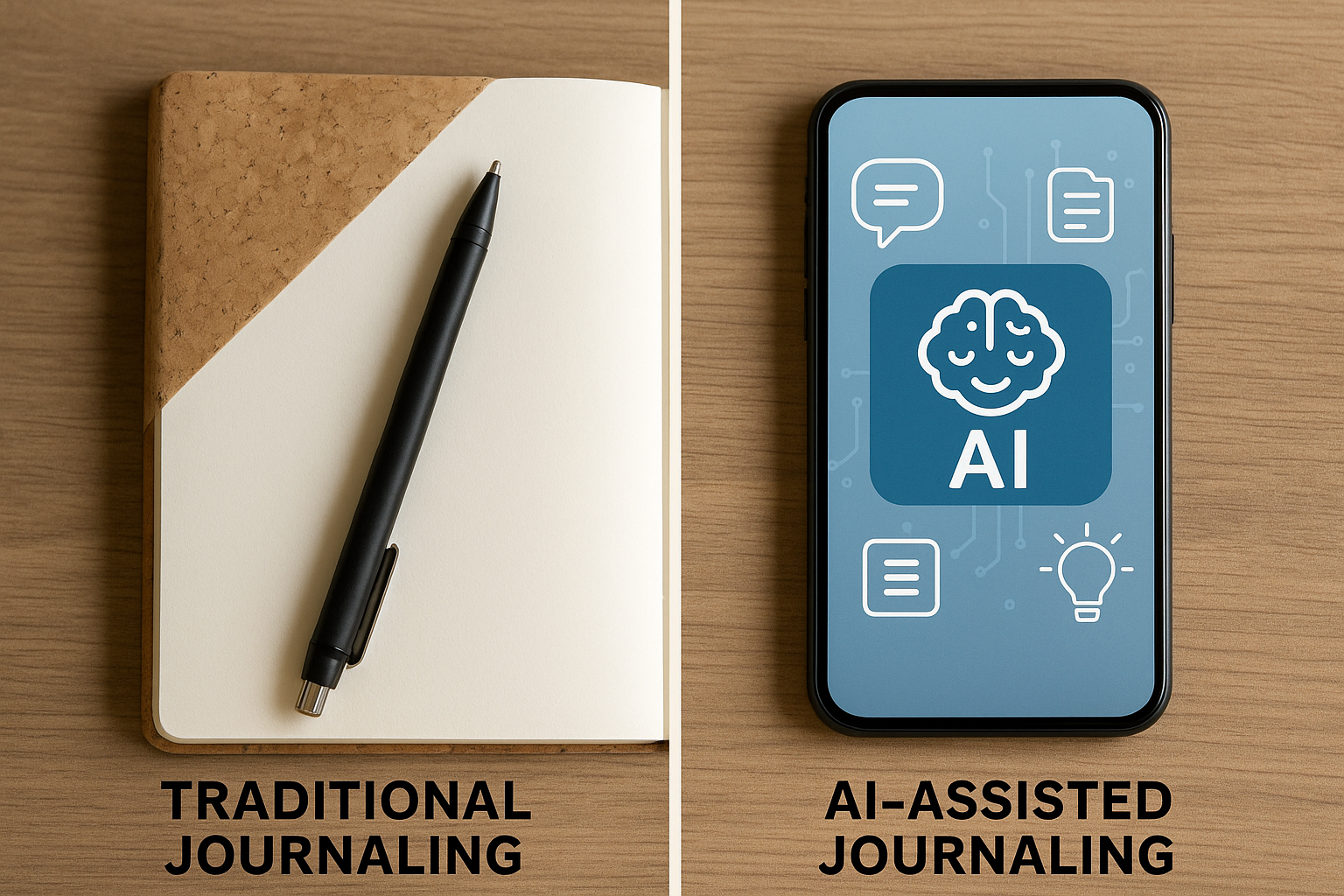
Journaling has been around for centuries. From handwritten diaries to digital note apps, the practice has always been about reflection, storytelling, and capturing life’s experiences. Now, AI-assisted journaling adds a new dimension to this long-standing habit. But how exactly does it differ from traditional journaling—and is it better, or simply different?
The Essence of Traditional Journaling
Traditional journaling, whether with pen and paper or in a simple digital diary app, centers on free expression. You decide what to write, how much to share, and when to stop. The value lies in the act itself—slowing down, becoming more mindful, and externalizing your thoughts.
Research shows that this kind of expressive writing can reduce stress, improve mood, and even support physical health outcomes (Pennebaker & Smyth, 2016). The process encourages self-reflection without interference, which is why many people still prefer a notebook or minimalistic app.
What AI Brings to the Table
AI doesn’t replace journaling—it reshapes it. Instead of being a blank page, AI-assisted tools act like a companion, offering prompts, summaries, and insights that would be hard to uncover on your own.
Here are some unique capabilities:
-
Smart Prompts
Struggling with writer’s block? AI can suggest questions tailored to your goals or emotional state. Studies in Frontiers in Psychology highlight that guided prompts make journaling more consistent and engaging (source). -
Summaries and Highlights
After writing, AI can condense your entries into key themes. This makes it easier to revisit months of journaling without rereading every word. Summarization techniques, long used in computational linguistics, now make journaling more accessible to time-strapped users. -
Mood and Sentiment Tracking
AI can analyze the tone of your writing and track changes over time, often linking them with mood logs. A study in JMIR Mental Health found that digital mood tracking improved emotional regulation and helped users identify triggers (source). -
Pattern Recognition
While humans notice only what’s obvious or recent, AI can connect dots across hundreds of entries. For example, it might reveal that your stress rises when you skip exercise, or that gratitude notes often correlate with better moods. Research in Nature Digital Medicine suggests such analysis can provide early warning signals for mental health changes (source).
Where the Skepticism Comes In
Some argue that AI-assisted journaling risks diluting the mindful, reflective nature of writing. There’s a concern that relying on AI to generate insights could create “cognitive offloading,” where the machine does the thinking for you. Psychologists studying digital tools warn that over-reliance on automation can reduce opportunities for deep reflection (Ward, 2017).
This skepticism is valid. The tactile, slow process of handwriting, for example, has been linked to deeper memory encoding and emotional processing compared to typing (Mueller & Oppenheimer, 2014). For many, that mindfulness is irreplaceable.
A Complement, Not a Replacement
The reality is that AI-assisted journaling and traditional journaling serve different needs. If your goal is mindfulness, slowing down, and pure self-expression, a notebook may remain your best companion. If you’re looking for feedback, pattern recognition, or help building a consistent habit, AI adds value that pen and paper cannot.
Think of AI as an assistant—there to nudge you, highlight connections, and make your self-reflection deeper. But the core act of journaling—choosing to write down your thoughts—remains entirely yours.
Takeaway
AI-assisted journaling differs from traditional journaling in important ways: it introduces smart prompts, automatic summaries, sentiment tracking, and long-term pattern recognition. These features can enrich the practice, especially for users who want structure or insights.
But it doesn’t replace the mindful, reflective benefits of writing freely. Instead, the two approaches complement each other. The best choice depends on your goals: mindfulness and self-expression may call for pen and paper, while growth and self-analysis might benefit from AI support.